

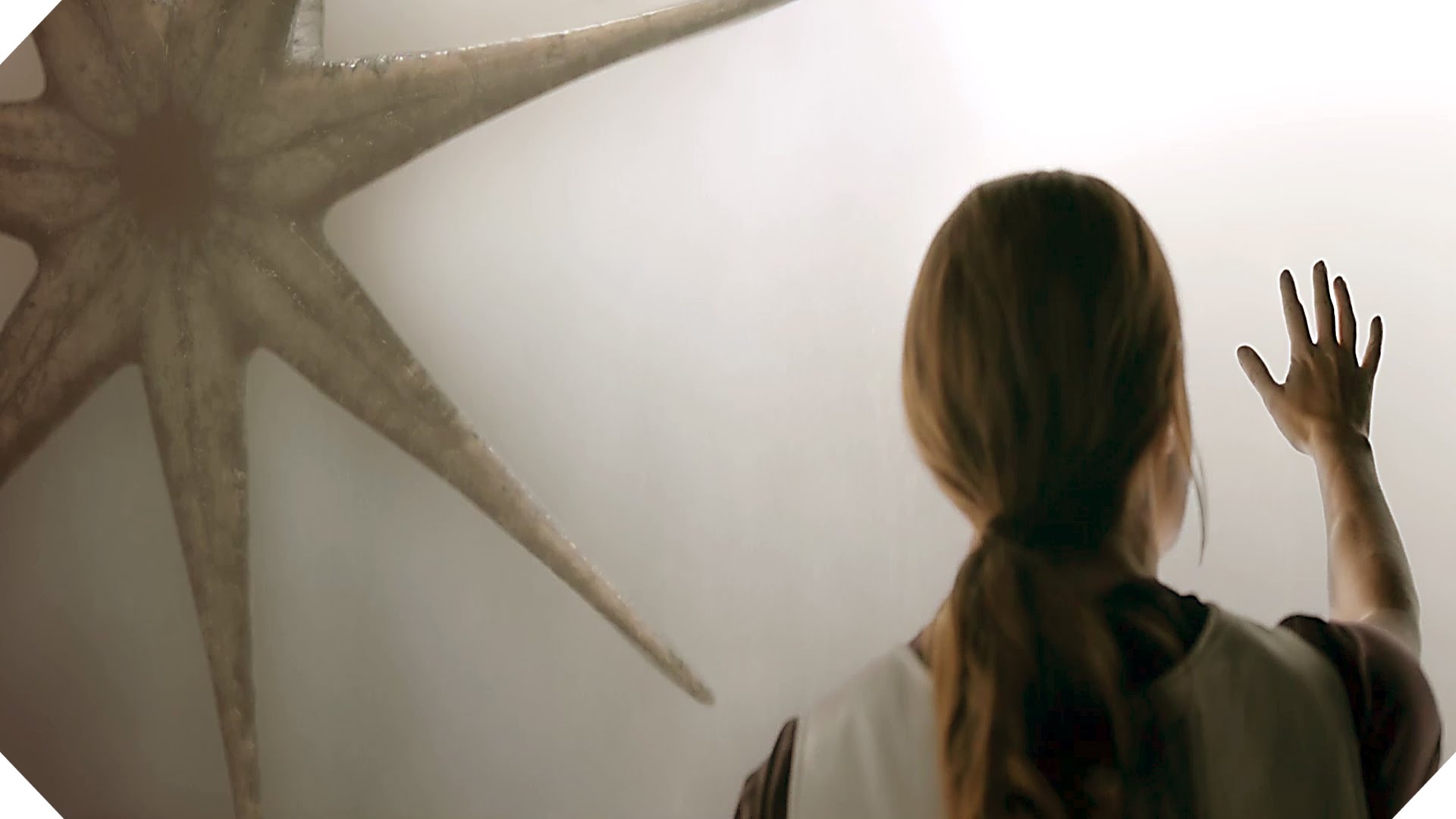
Enlarge / Louise (Amy Adams) gives the first alien high-five in human history.
Arrival is the riveting, slow-burn story of an alien encounter that’s satisfyingly complex. Instead of showing how we blow up the buggers, this movie poses a difficult question: how would we communicate with seemingly peaceful aliens whose language is as impenetrable as whalesong? The welcome surprise is that Arrival explores the answers without shying away from the reality of how linguistics work, as well as the geopolitical consequences of first contact.
Louise (Amy Adams) is a gifted linguistics professor who has done some spot work for the government translating videos made by foreign insurgents. As the film opens, her quiet classroom life is disrupted permanently when a dozen enormous spaceships materialize over seemingly random regions across the world. Made of no materials we recognize, and emitting no chemical signatures whatsoever, the ships hover like perfectly curved stones just above the ground. Twice per day, an opening appears in the bottom of each ship, admitting humans into the gravitationally bizarre interior to meet with squidlike aliens who hover in what seems to be an atmosphere chamber behind a transparent barrier.
Dubbed heptapods for their five legs, the aliens make noises that are completely incomprehensible. When military officer Weber (Forest Whitaker) plays a recording of one to Louise, demanding a translation, she can’t even figure out what kind of organ could produce the noises. “Do they have… mouths?” she asks, bewildered. Despite her initial confusion, Louise manages to crack the alien code by using writing to communicate with them rather than speech.
Read 8 remaining paragraphs | Comments
Source: Ars Technica – Arrival proves that first contact movies can still blow your mind