

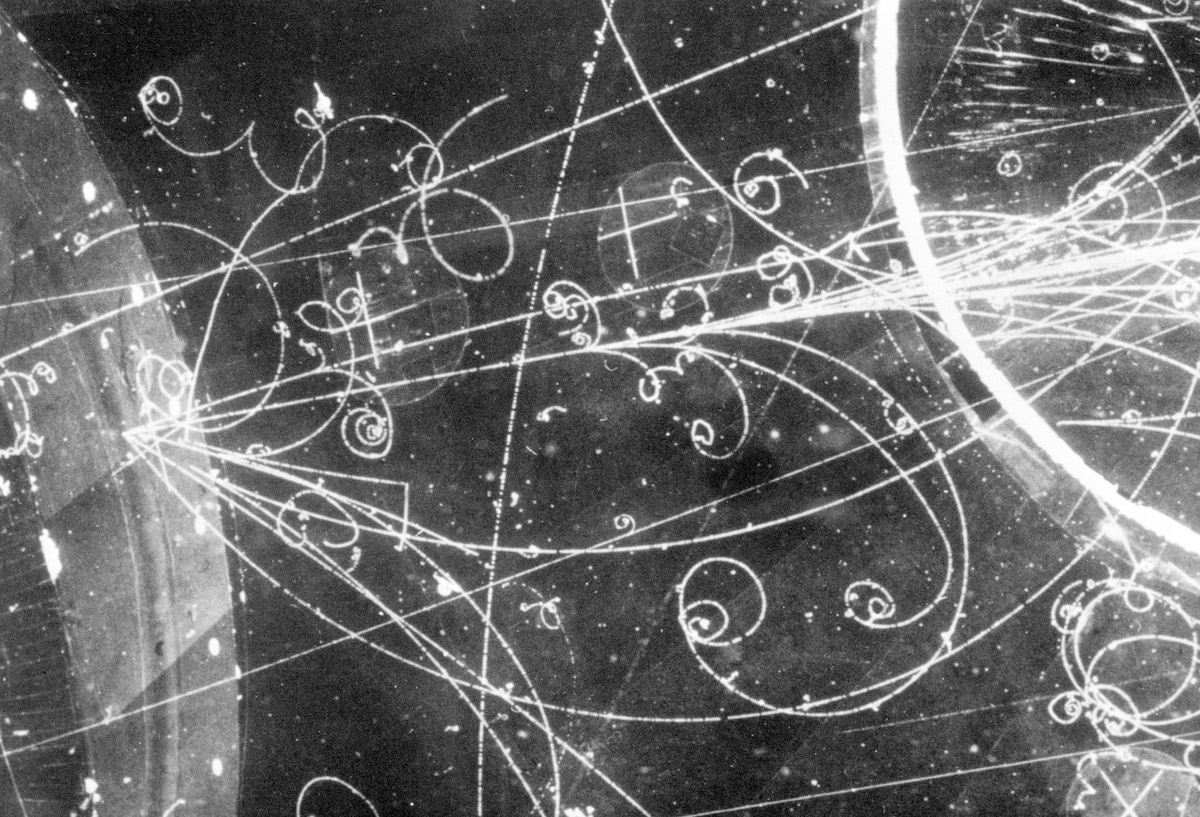
Enlarge / If you saturate the air with water vapor, passing particles leave trails of ions that allow water droplets to condense. (credit: Fermilab)
If you’re going to question the understanding of our climate that has built through more than a century of observation and experiment, you have to do two things. One is to show that this understanding is fundamentally limited in some way. The second is to provide an alternate explanation for the patterns in the climate.
One of the ideas that has seemingly fit the bill is a connection between radiation and clouds. Ionizing radiation from cosmic rays and other sources could create ions in the atmosphere, which could then draw in water molecules. These would form the building blocks of clouds, which would then influence the climate. The amount of radiation reaching the atmosphere does change, in part because the Sun’s magnetic field, which protects the Earth from incoming radiation, varies over time.
Put these ideas together, and variations in the Sun’s magnetic field could have an influence on the climate. It’s a nice idea, but the latest paper from CERN should finally put it to rest. (But of course, it probably won’t.)
Read 11 remaining paragraphs | Comments
Source: Ars Technica – Sun-clouds-climate connection takes a beating from CERN