

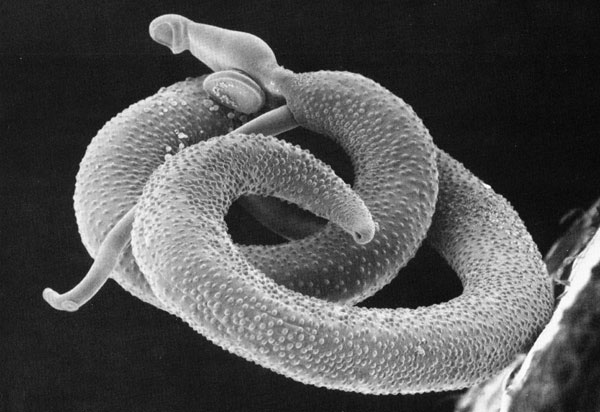
Enlarge / Scanning electron micrograph of a pair of Schistosoma mansoni. They live inside your blood! (credit: Uniformed Services University of the Health Sciences)

A number of studies have shown that political and personal beliefs can be related to health behaviors. For example, political orientation may be affected by a person’s beliefs about community, self-reliance, and morality, and these same beliefs may influence that person’s likelihood of seeking treatment for a potentially stigmatizing condition, such as a mental or a sexual health issue. A recent article published in PNAS expands on past findings, suggesting that individual traditionalism is associated with national parasite stress.
The study recruited participants from 30 countries, with at least 200 people enrolled per country. These participants completed a short questionnaire describing their attitudes towards political issues and groups of people.
This questionnaire was intended to probe participants’ attitudes on three things: traditionalism, social dominance, and sensitivity to feelings of disgust. Traditionalism was assessed in terms of adherence to old-fashioned values, a family focus, and religiosity. Social dominance orientation was assessed in terms of how much participants favored inter-group equality. Finally, disgust sensitivity was assessed in terms of responses to various situations such as “stepping on dog poop.”
Read 7 remaining paragraphs | Comments
Source: Ars Technica – Strong sense of tradition may be influenced by risk of parasite infections