

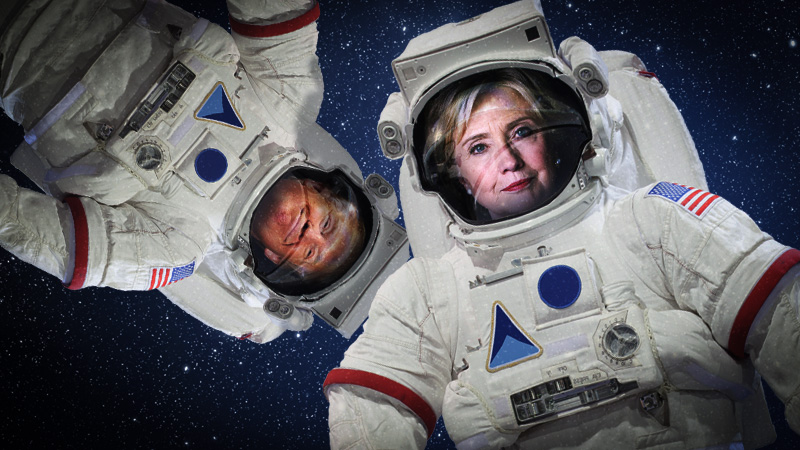
Enlarge / Trump and Clinton, should we send them into space? (credit: Aurich / Getty)
At the upper edge of the atmosphere, where the sky kisses outer space, a few molecules of nitrogen and oxygen bounce around. If we consider the presidential election as playing out at the surface of the Earth, amid a thick atmosphere of invective and accusation, it is not a stretch to say the relative importance of space policy lies somewhere near the edge of space, bouncing around inconsequentially, like these stray molecules.
Even so, the next president of the United States will have the ability, if not the desire, to shape the future of America’s civil space programs—especially with major decision points on the horizon, including the privatization of spaceflight and the details of where humans should go beyond low-Earth orbit. For this reason, we’re going to look at what changes a new president might make and what attitudes each candidate has had toward space.

Among the first tasks of a new administration is to launch a transition team to review major federal programs. With a budget that comprises about 0.4 percent of all federal spending and a significant chunk of the country’s discretionary funds, NASA will face meaningful scrutiny. Such transition teams will delve far beyond the rhetoric of hashtags, like #JourneyToMars, and get under the hood of the space agency’s programs and whether funding exists to carry them out.
Read 27 remaining paragraphs | Comments
Source: Ars Technica – The next President will take power with significant space decisions looming