

Enlarge (credit: IBM)

For most of humanity’s existence, communication has been incredibly slow. For millennia the only way of transmitting information between two humans was via speech or crude drawings. About 5,000 years ago written language and papyrus increased the transmission distance and bandwidth of human-human communication, but the latency, delivered by hand, was still pretty bad.
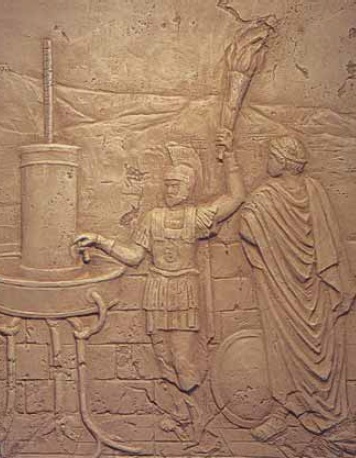
A relief of the Greek hydraulic telegraph of Aeneas, depicting one half of the system.
Somewhere around 300BC, though—at least according to recorded history—things started to get interesting. Ancient Greece, as described by the historian Polybius, used a technology called hydraulic telegraph to communicate between Sicily and Carthage—a distance of about 300 miles—in the First Punic War.
The system was essentially a slightly higher bandwidth signal fire, with a long unbroken line of humans standing on hilltops with identical telegraph machines. There was still a fair bit of latency, of course, as the humans tweaked the hydraulic levels, but near-speed-of-light electromagnetic radiation was quite a bit faster than papyrus-by-horseback (like the classic example of “driving across the country with a van full of tapes,” though, the bandwidth was probably lower).
Read 12 remaining paragraphs | Comments
Source: Ars Technica – Humanity’s war on latency: Semaphore to silicon photonics and beyond