

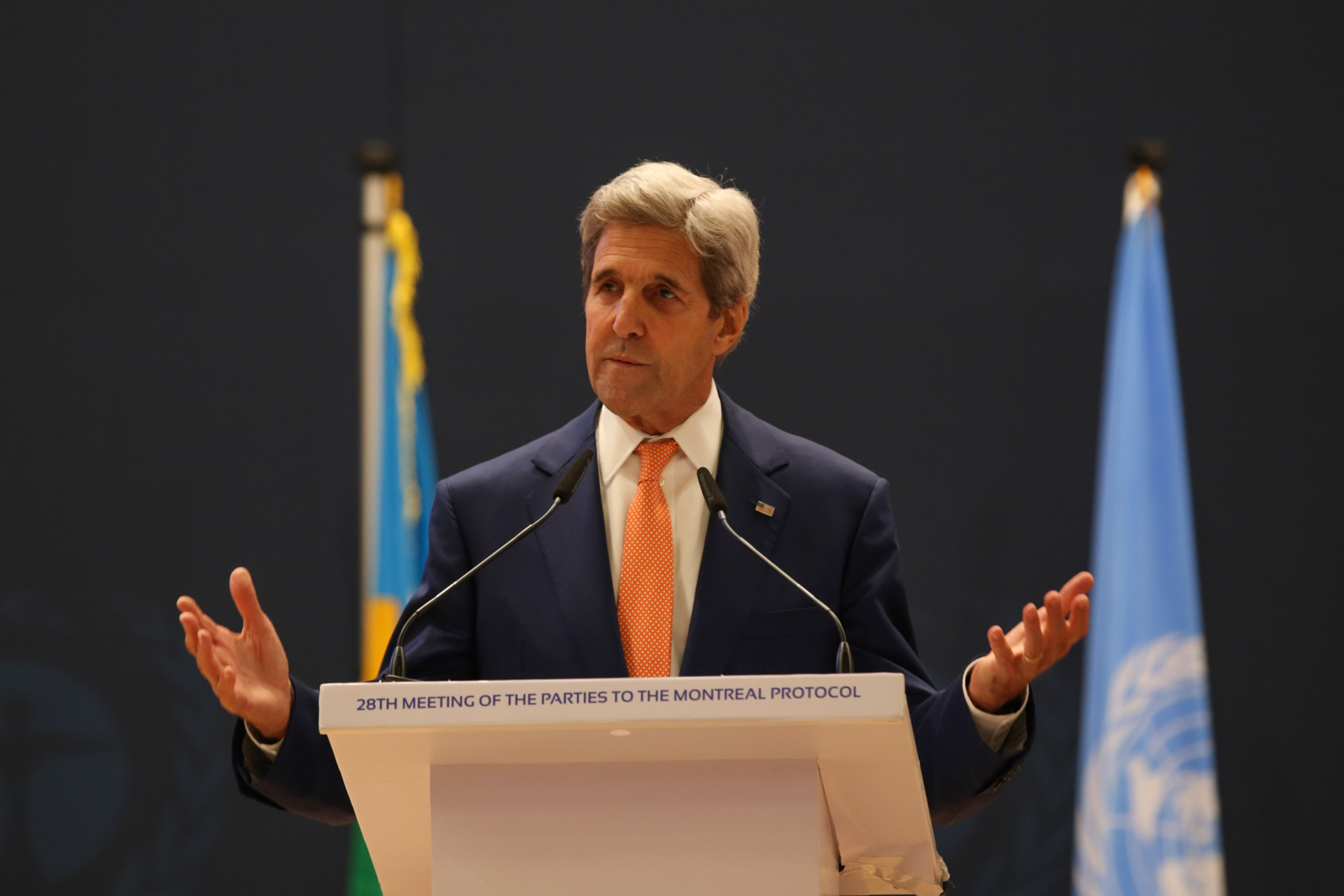
Enlarge / US Secretary of State John Kerry speaks in Kigali, Rwanda. (credit: IISD/ENB | Kiara Worth)
Because of the 1987 Montreal Protocol, NASA was able to call a video about the ozone layer “The World Avoided.” In a model for international agreements, the world’s nations came together in response to research revealing a dangerous trend of ozone destruction driven primarily by chlorofluorocarbons—used as refrigerants and, yes, propellants in aerosol cans. The agreement that ensued dealt with the problem.
There’s a common misconception that global warming and ozone depletion are one and the same, but they are separate phenomena with separate causes. The two phenomena do actually intersect with each other, however. Apart from destroying stratospheric ozone, some chlorofluorocarbons are tremendously potent greenhouse gases. The concentration of these gases in the atmosphere is very, very small, but their potency makes them more than a rounding error for climate change. That means the Montreal Protocol has also helped us avoid a bit of planetary warming.
Chlorofluorocarbons were largely replaced with hydrofluorocarbons, which are ozone-safe. Unfortunately, they’re also extremely potent greenhouse gases. UN talks eventually started up again with the goal of pushing a second transition to chemicals that are safe on both counts. As more and more air conditioners come online in developing economies like India, the leakage of hydrofluorocarbons into the atmosphere has been growing rapidly, adding urgency to the talks.
Read 3 remaining paragraphs | Comments
Source: Ars Technica – New agreement will end use of refrigerants that enhance climate change