

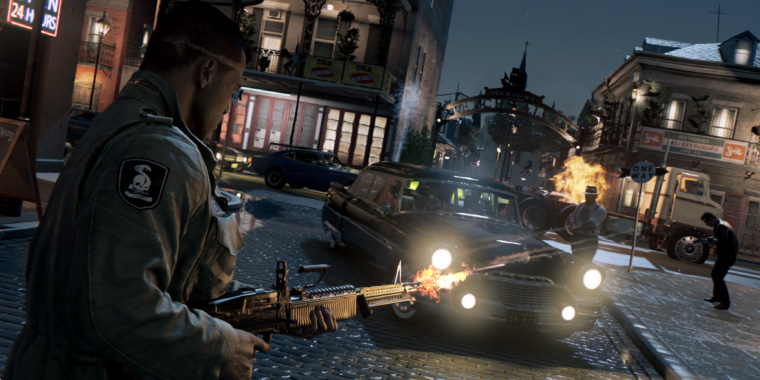
Mafia 3‘s first few hours are some of the best you’ll play this year—but the next few dozen are among the most disappointing.
Following on from the well written but mechanically limited Mafia 2, developer Hangar 13 has used this opportunity—in which is incidentally its debut game—to shift the series’ perspective entirely, with mixed results. So rather than fixating on the made men of the ’40s and ’50s, Mafia 3 moves to the late ’60s, and the heavily stylised city of New Bordeaux. The ’60s were a vibrant, culturally rich time and Mafia 3 captures the southern American soul of a Louisiana-inspired city fantastically well. From its big American cars—with their wide girth, chrome bumpers, and enormous steering wheels—to Hendrix riffs and the high-pitched tones of the Rolling Stones, Mafia 3 is an accomplished exercise in period world-building.
The city is rich and varied, with lovely details and intricate little flourishes bringing the entire place to life, despite a handful of technical failings (more on that later). The newfound focus on the African-American mob takes a mature and considered approach to the oppressive attitudes of the times, too. It’s unflinching and often unpleasant, but the depiction of racism is sensitively handled, without ever feeling gratuitous.
You play as Lincoln Clay—a young, biracial orphan fitting an interesting Henry Hill archetype that embodies loyalty and decency, despite a penchant for everything criminal. Having recently returned to New Bordeaux after a stint in Vietnam as a special forces soldier, Lincoln hits the streets to help out his surrogate father, Sammy, who’s also the leader of the local black crime organisation.
Read 19 remaining paragraphs | Comments
Source: Ars Technica – Mafia 3 review: Style over substance